
Let’s be honest, nobody told you that summer has a nutrition protocol. You were handed the same diet advice in May that you got in December, and you’ve been wondering why nothing’s working, why you’re exhausted by 10am, why your digestion feels off, and why your usual workout is leaving you completely wiped.
This is not a seasonal wellness trend. The physiological changes that happen in your body when ambient temperature crosses 35°C are significant, measurable, and well-documented. Your metabolism shifts. Your digestion slows. Your electrolyte needs change. Your cardiovascular demand increases even at rest.
India recorded over 40,000 heatstroke cases in summer 2025, and the majority were not outdoor workers, they were regular people going about their lives indoors, under-hydrated, under-fuelled for the heat, and overtraining in peak temperatures.This guide exists so that’s not you.
1. What Heat Actually Does to Your Body
Before we talk about what to eat, let’s understand what’s happening inside you — because the dietary changes make no sense without this foundation.
Thermoregulation and blood redistribution
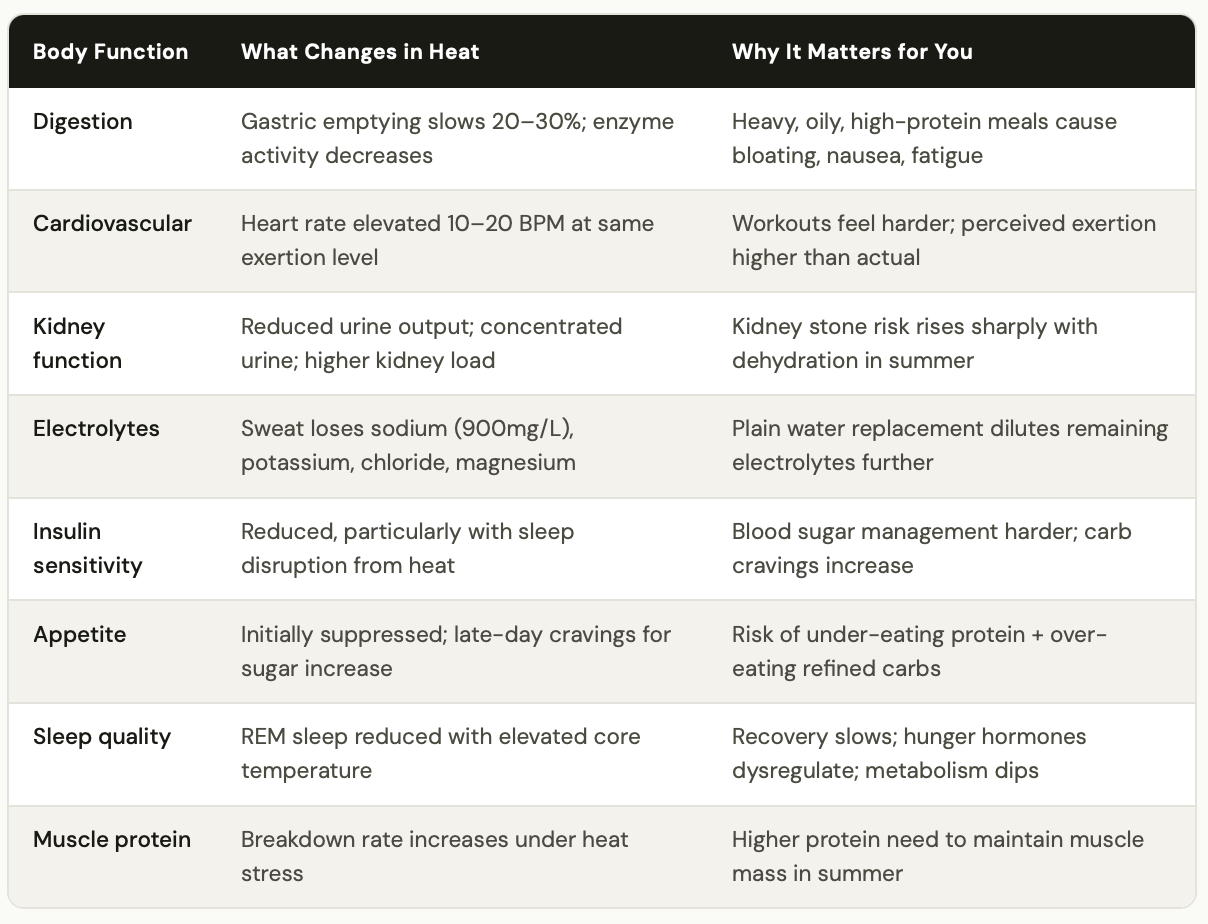
When environmental temperature rises, your hypothalamus triggers cutaneous vasodilation blood vessels near your skin dilate to dissipate heat. This is your body’s primary cooling mechanism. The problem: this diverts blood away from your digestive organs, your muscles, and your brain to your skin surface.
The result? Slower gastric emptying (food sits in your stomach longer), reduced digestive enzyme activity, and a measurable drop in cognitive performance that afternoon brain fog is real and physiologically explained.
What changes and what doesn’t
2. Hydration: Why Plain Water Is Failing You
This is the single most misunderstood aspect of summer health in India. Everyone is told to “drink more water.” Most people do. And most people are still dizzy, still cramping, still fatigued. Here’s why.
The electrolyte equation
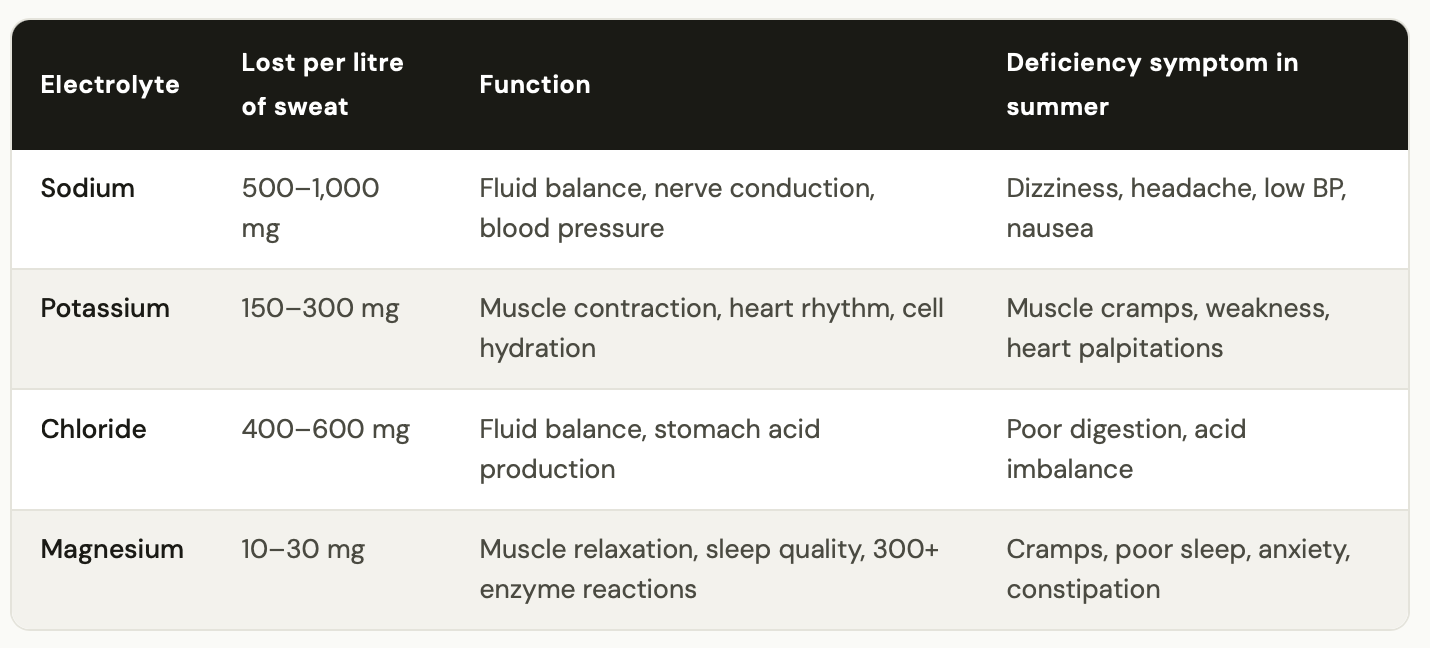
When you sweat, you don’t just lose water. You lose sodium, potassium, chloride, and magnesium these are the minerals that regulate fluid balance inside and outside your cells, drive muscle contractions, and maintain blood pressure.
Drinking plain water when you’re sweating heavily dilutes the electrolytes that remain in your blood. This is called exercise-associated hyponatraemia (EAH) in clinical literature, and its symptoms are dizziness, headache, nausea, muscle cramps, confusion are identical to dehydration. Most people treat it by drinking more water, making it worse.
⚠️ WHO IS MOST AT RISK?
Women with hormonal/metabolic conditions may feel heat stress more, but electrolyte loss depends primarily on sweat rate
How much do you actually lose?
The best hydration sources
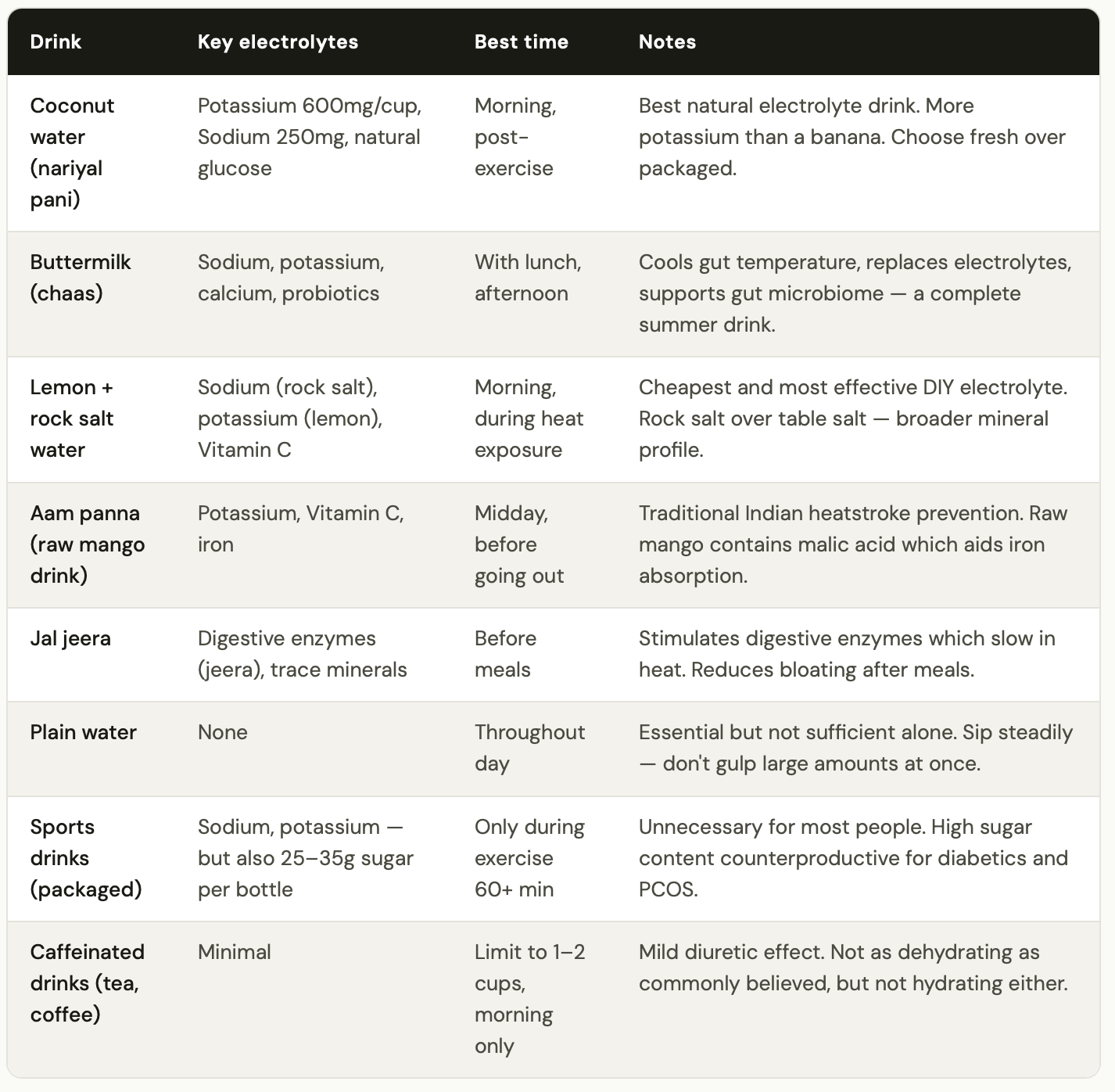
The daily hydration formula
A simple evidence-based target 35ml per kg of body weight per day, as a baseline.
For a 60kg person that’s 2.1 litres. Add 500ml for every 30 minutes of moderate-intensity activity in heat, and more on days above 40°C.
How do you test if you are drinking enough water ?
THE URINE COLOUR TEST: Pale straw yellow = well hydrated. Dark yellow = drink more. Colourless = potentially over-hydrated and diluting electrolytes. This is the simplest real-time hydration check and more reliable than counting glasses.
3. What to Eat (and What to Avoid) in Indian Summer
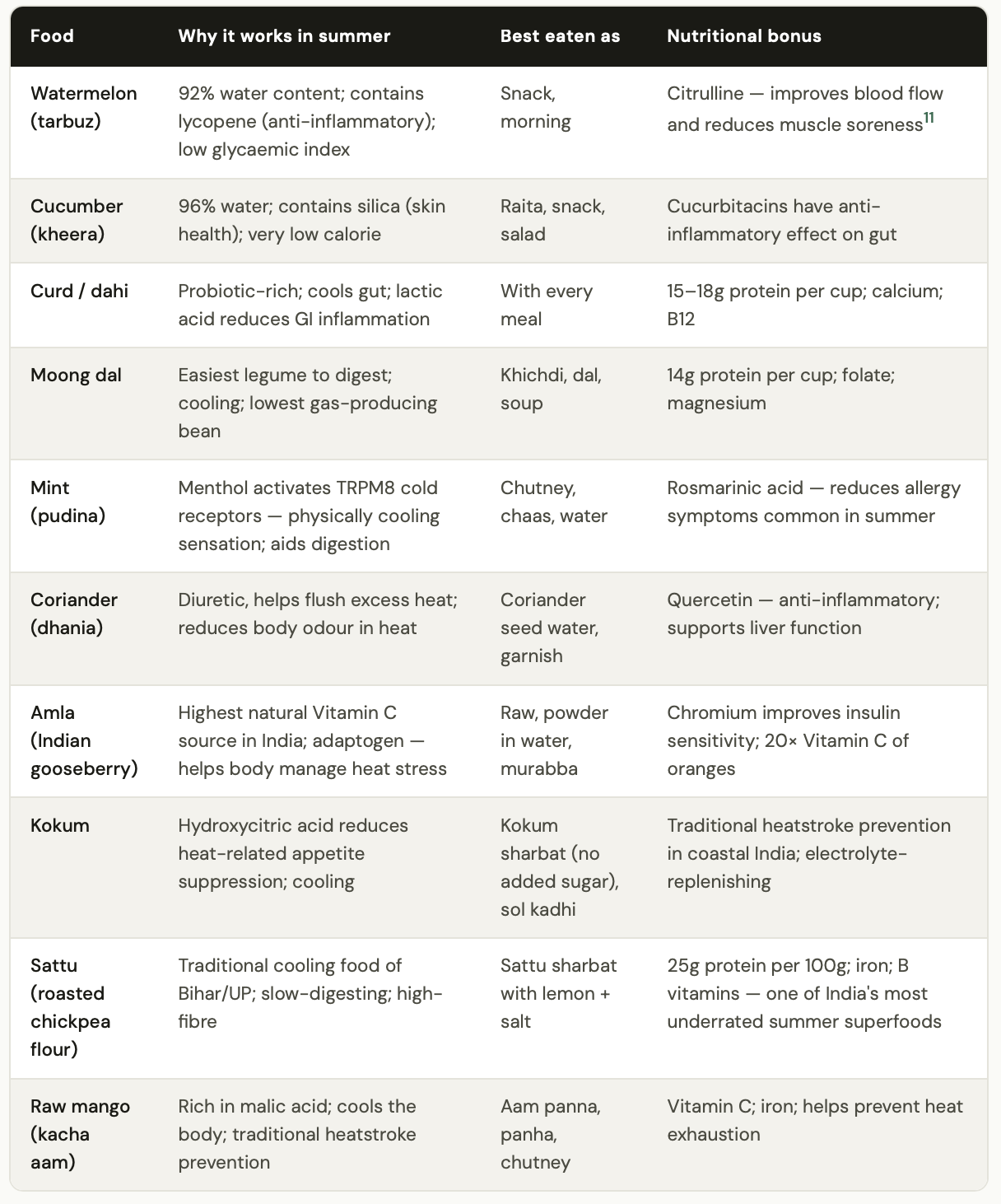
Summer eating is not about restriction it’s about alignment. The foods that work best in summer are lighter on your digestive system, high in water content, cooling in their thermogenic effect, and easy to absorb even when enzyme activity is reduced.
The cooling foods framework
Ayurveda has categorised foods as heating (ushna) and cooling (sheeta) for centuries and modern nutrition science largely validates this framework. Cooling foods tend to have higher water content, lower thermogenic effect, and in many cases, specific compounds (like the saponins in moong or the alkaloids in coriander) that reduce systemic inflammation.
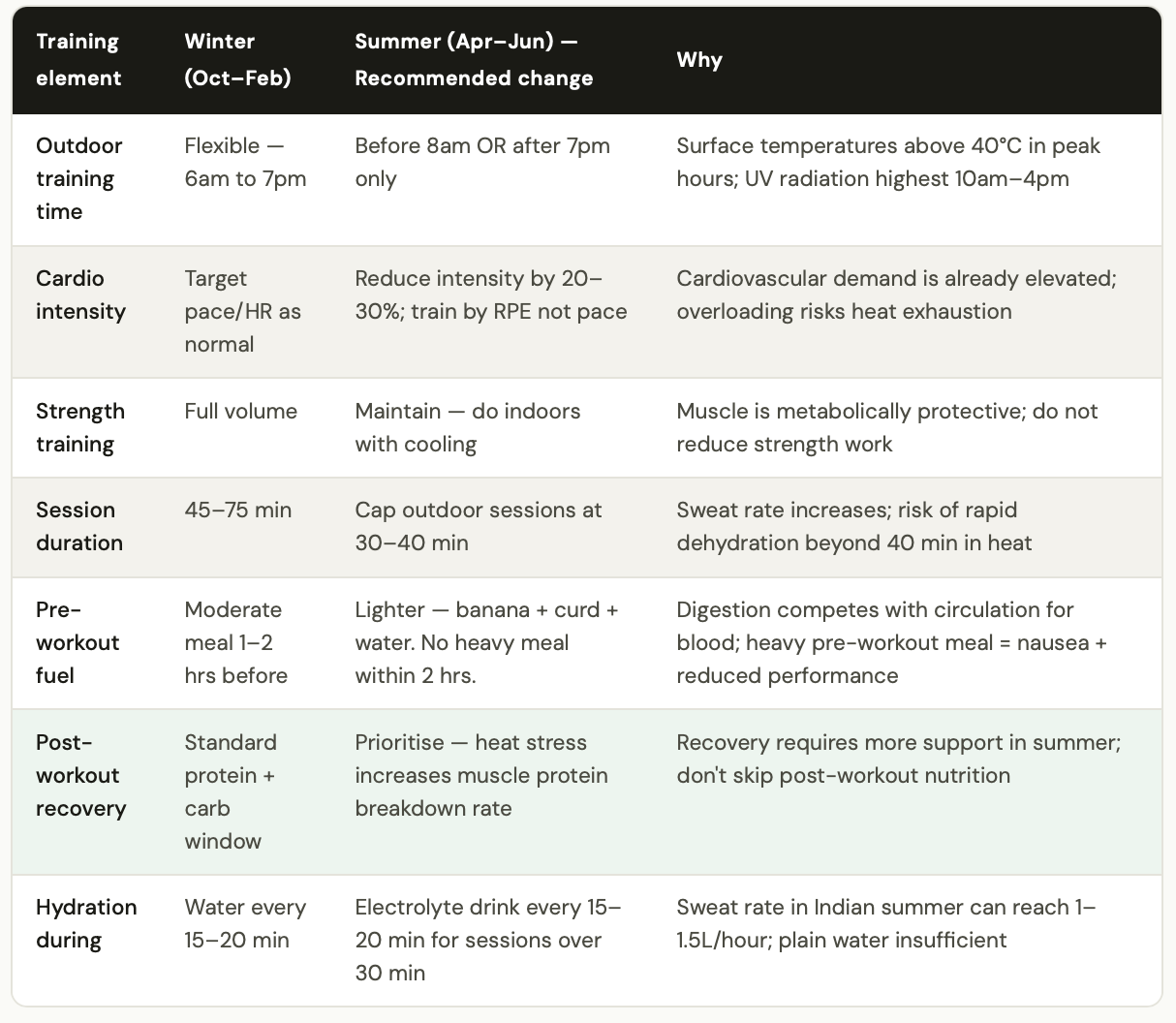
4. Training in Summer — What Changes and What Doesn’t
Let’s clear this up: you don’t stop training in summer. You train smarter. The evidence on this is unambiguous exercise is protective against heat illness, not causative, when properly timed, fuelled, and modified.
The heat tax on performance
The physiological cost of exercising in ambient temperatures above 32°C is measurable and significant. Your heart has to simultaneously pump blood to working muscles AND to your skin for cooling. This cardiovascular competition means your heart rate at any given effort level is 10–20 BPM higher in summer than in cooler conditions. This is why the same workout that felt manageable in February feels brutal in May it actually is harder, not a perception.
6. A Complete Summer Day on a Plate
Here’s what a well-designed summer day of eating looks like — practical, Indian, and clinically optimised for heat. This is not a weight loss meal plan. This is a performance-in-heat plan.
Optional: 1 tsp methi seeds soaked overnight, drained and eaten. Why: replenishes overnight electrolyte loss, primes digestive enzymes, mild blood sugar stabilisation from methi.
Option B: Ragi moong dal cheela (2 pieces) + hung curd + mint chutney → ~18g protein, GI 28, gut-cooling.
Drink: Coconut water or amla juice. No coffee until after breakfast.
After lunch: Chaas (buttermilk, salted, with jeera and mint). Walk 10–15 minutes. Why: post-meal walk drives glucose into muscles, reduces post-lunch blood sugar spike by up to 25%.18
Best options: Roasted chana (30g) + jal jeera · Sprouted moong chaat · Sattu sharbat (2 tbsp sattu + lemon + rock salt + water) · Greek yogurt with cucumber. Avoid: biscuits, packaged namkeen, fruit juice.
Optional: 1 glass warm haldi milk (turmeric + warm (not hot) milk + black pepper) — anti-inflammatory, aids sleep.
The full day at a glance — nutritional summary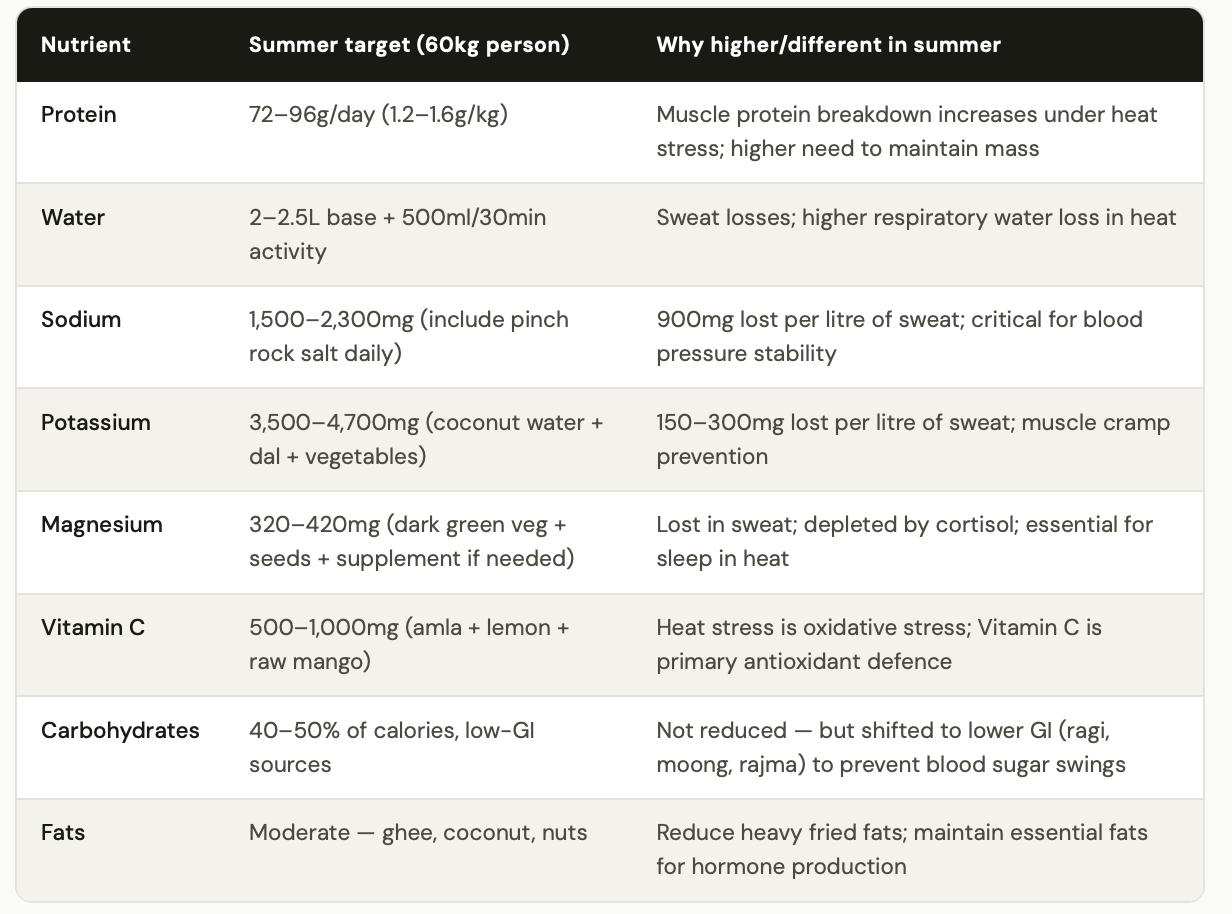
TAKE THIS WITH YOU
Summer is not a season to white-knuckle your way through. It’s a season that asks for a different relationship with food, water, movement, and rest. The body doesn’t need you to push harder — it needs you to be smarter. Eat lighter, hydrate beyond plain water, move in the cooler hours, sleep in a cool room. These are not restrictions. They are the conditions under which your body performs best at 42°C.
If you have PCOS, thyroid issues, diabetes, or gut health concerns the special guidance in Section 4 is specifically for you. Your baseline is different. Your summer protocol should be too.
Have questions about your specific situation? DM @dietitian.meghaterse on Instagram or visit myhealthsprint.com for a personalised consultation.